
Frisco ISD’s Bond Planning Committee held its second meeting this week, examining needs in technology, transportation, fine arts and athletics as members work toward a potential 2027 bond proposal.
But first, Kimberly Smith, deputy superintendent of business and operations, acknowledged the community’s top questions: How is Frisco ISD declining in enrollment but also in need of bond funds? Is there some solution to address facility needs while closing under-capacity campuses?
These are important questions, Smith said, but the timing of long-term closures does not align with immediate facility needs.
“School closure could very well be part of our future, and we are absolutely having those conversations,” she said. “At the same time, we are educating 62,000 students in Frisco ISD buildings. We have an obligation to those students to make sure they’re going to school in a safe learning environment, in a building that is heated and cooled properly.”
Smith said potential school closure is a parallel conversation happening during bond talks.
While District leadership is monitoring campus enrollment, initiatives such as Access Frisco have proven to help moderate the enrollment decline thus far.
Smith also reiterated the importance of responsible planning, including avoiding major renovations to campuses that could later close.
“We are all committed to not putting money into a major school renovation, and then turning around and closing that school,” she said. “We recognize that that is not a good use of taxpayer dollars.”
Student fine arts and athletics equipment
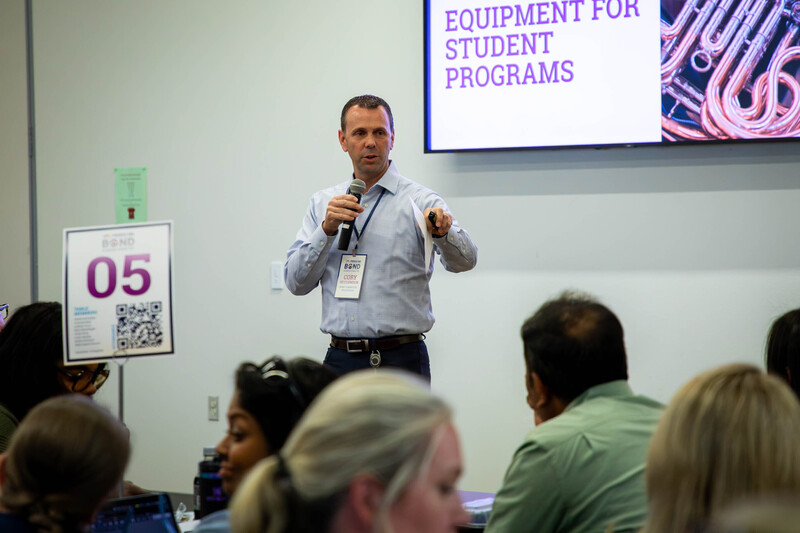
Committee members reviewed proposed bond spending on fine arts and athletics, focusing on sustaining existing programs rather than adding new facilities.
“Back in 2018 and 2024, there were a lot of items around the idea of expansion. That’s not what you’re going to see in this proposal,” said Cory McClendon, deputy superintendent of schools. “There’s nothing new and shiny here.
“It’s about sustainability — we want to make sure we maintain the quality of our programs.”
Sustaining these programs will mean replacing existing assets that are broken or worn out, such as equipment and uniforms, and FISD has been stretching replacement timelines as far as they can go.
For example, while FISD is getting three or four years out of light-colored football uniforms, a neighboring district is replacing theirs after two years, said Chris Burtch, managing director of athletics. Band uniforms are expected to last eight years; in Frisco ISD, they are replaced at 10 years.
McClendon also mentioned equipment that needs replacement over time, such as weight room flooring and safety pads around indoor facilities, gyms and doors. He also said due to new UIL regulations that will be implemented in a couple of years, all scoreboards must have a shot clock that is connected to the scorer’s table.
McClendon said none of Frisco ISD’s scoreboards have this feature and will need to be retrofitted to be in compliance.
Committee members asked about project details, like which instruments, uniforms and equipment need replacement when and on what campus. District staff pointed them to itemized lists provided in committee materials.



Technology devices and infrastructure
Technology was another major topic, including replacing aging classroom devices and maintaining network infrastructure.
Cheryl McDonald, chief technology officer, explained that regular replacement cycles help support instruction, cybersecurity and state testing demands, while reducing disruptions caused by outdated equipment.
Between 2026-27 and 2027-28, state testing requirements will triple for third through 12th grade, making devices, network infrastructure and server reliability more important than ever.
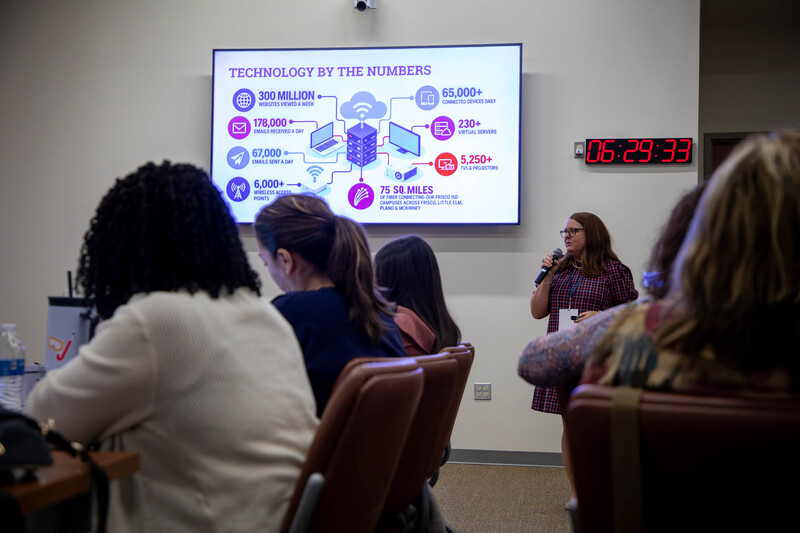
She also shared some significant numbers of note:
300 million - Websites visited per week
178,000 - Emails received per day
65,000 - Devices connected daily
6,000+ - Wireless access points
230+ - Virtual servers
75 - Square miles of fiber connecting FISD campuses across Frisco, Little Elm, Plano and McKinney
Frisco ISD provides a device to every student, including take-home Chromebooks in secondary through its 1 For All program. Before 2025, about 20% of high schoolers brought their own device from home rather than use an FISD-provided Chromebook. However, in 2025, HB 1481 was passed, banning personal devices brought from home.
“So we had to figure out quickly where we would get 2,500 devices and give them to the kids who used to bring their own,” McDonald said. “Sometimes things happen that we don’t plan for.”
Committee members asked about leasing devices rather than buying, which Smith explained is not allowed with bond funds. Passing that device lease to the annual maintenance and operations budget is also not feasible because of budget deficits, she said.
“Any additional expense through the M&O side is going to take away from something else,” Smith said. “School districts operate on a fixed income. We have to cut something in order to spend on something, and we actually have to cut extra because we’re in a deficit situation.”
Delaying technology replacement brings higher costs, as well. McDonald gave an example of a specialized computer at the Career and Technical Education Center that cost $2,400 in 2024, and costs $3,200 today. These computers are used in architecture, engineering, esports, 3D modeling and 3D animation courses.
Reviewing transportation needs
The committee also discussed bus replacement needs and a new state requirement for three-point seat belts for every passenger and driver.
Frisco ISD has 243 buses without the required seat belts, and retrofitting them by the deadline of Sept. 1, 2029, would void existing warranties.
Many of the buses that could be retrofitted are also near the end of their lifecycle, so spending the money to retrofit would be wasted if the bus needs to be replaced soon anyway.
While the cost to replace one bus is $188,000, putting off that purchase would bring risks.
“As vehicles age, repairs become more frequent and breakdowns happen. That’s never ideal when you’re taking students home,” said Jerad Castor, director of transportation. “If we delay, we could also be looking at potentially higher future replacement costs.”
Castor explained the scope of his department through some eye-opening numbers:
200 - Buses that leave out of three FISD transportation facilities each day
15,000 - Students transported daily on FISD buses
1,000 - Runs driven every day
50 - Mid-routes driven daily, such as field trips and trips to the CTE Center
Throughout the meeting, members asked questions about costs, proposed projects and alternatives, and after each discussion and Q&A, were asked to share their impression of the project and whether it was needed in a possible bond.
What’s next
Upcoming meetings will continue to explore potential facility needs, financial guardrails and ways to help the community better understand the District’s needs.
Learn more about the Frisco ISD Bond Planning Committee and follow the process.
Resources
Bond Planning Committee updates
Transparency tools
Capital Projects table, updated October 2026: Category, Project, Amount Spent and Remaining Balance
Your Frisco ISD Taxes at Work: A dollar-by-dollar breakdown of where your taxes are going
Sustainability Plan
November 2026 update: Board workshop Nov. 9 from 5-7 p.m. at the FISD Administration Building, 5515 Ohio Drive, Frisco, TX 75035
June 2026 update: Expense cuts, new revenue and campus utilization. Article | Presentation | Video
January 2026 update: Cost savings and resource realignment. Article | Presentation | Video
October 2025 update: Demographics, facility planning and academic programs. Article | Presentation | Video