
Frisco ISD’s Career and Technical Education Center earns well-deserved praise for career pathways that prepare students for their futures. From culinary arts to accounting to video game design, students are developing industry skills before they graduate.
Few people may know just how quickly that learning is getting started.
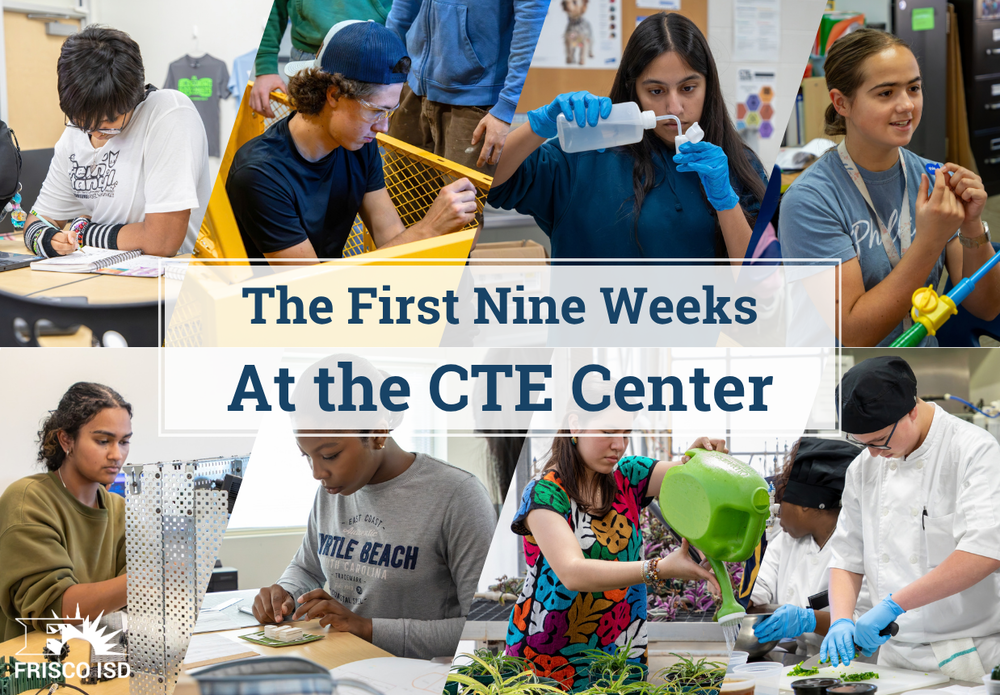
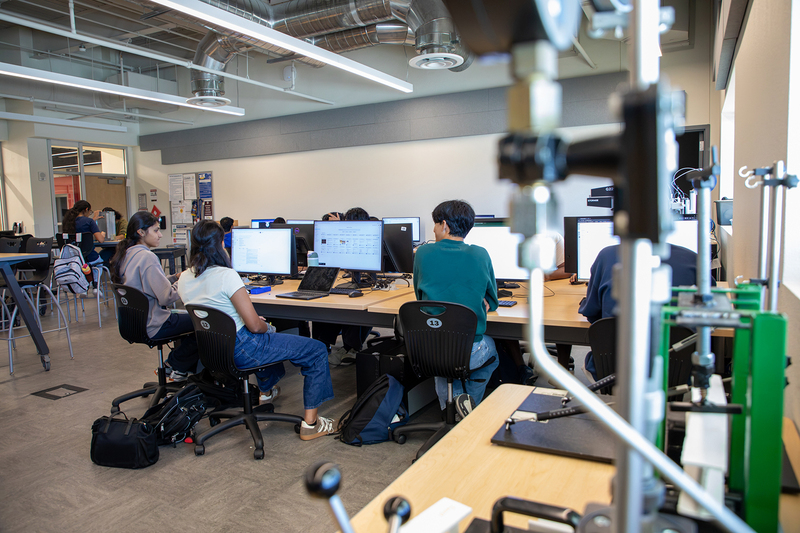
In the first nine weeks, the CTE Center is a hive of hands-on learning. The shop is loud with whirring machinery. The greenhouse blooms as students plant and water. The kitchens smell of savory tarts, pencils scratch out illustrations in the graphic design class, and the buzz of collaboration can be heard in architecture and engineering classes.
While students can take career and technical education courses on their home campuses, they attend the CTE Center for advanced classes on those pathways. For example, Intro to Culinary Arts is offered at FISD high schools, while Culinary Arts 2 and 3 can be taken at the CTE Center.
A visit to the CTE Center during the first nine weeks shows just how students are getting started on their futures, right now. Take a look inside some of those classrooms.
Part One: Architecture, Education and Engineering
Part Three (coming Wednesday): Culinary Arts, Agricultural Mechanics and Veterinary Science
Architecture
Class visited: Architectural Design II | Teacher: Clarzell Gilleylen
Architecture and Construction programs of study
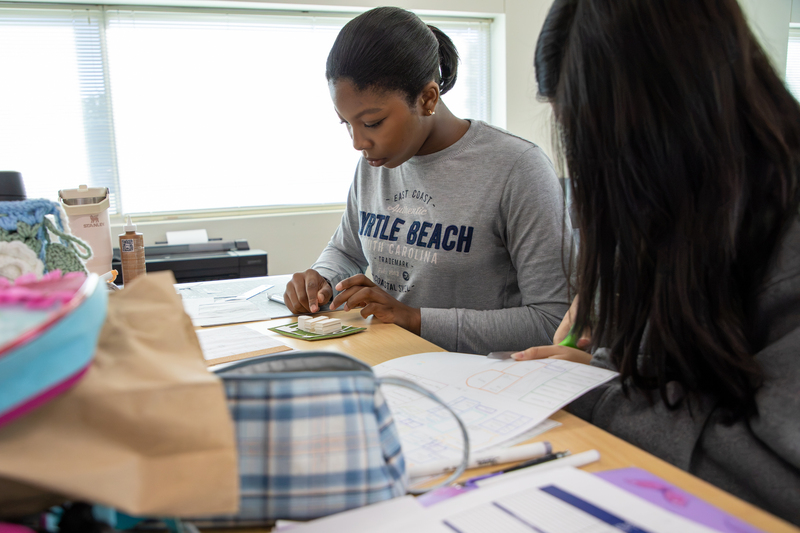
Architectural Design II students are serious about design; you’d have to be, to get to the top, fourth-year class in the pathway.
One of those students is Neriah Michael-Odigie, an Independence senior. She signed up for architecture freshman year to earn the tech credit required for graduation, but was also “curious about the design process as a whole.”
“Now four years later, I’m choosing to major in architecture.” Neriah Michael-Odigie, CTE Center student
In the first nine weeks, architecture students across all levels are learning and working on:
Perspective Drawing (level 1)
Modern architectural history (level 2)
Contrasting relationships (a design theory on how to establish focal points using design form) (level 3)
Designing a Montessori academy (level 4)
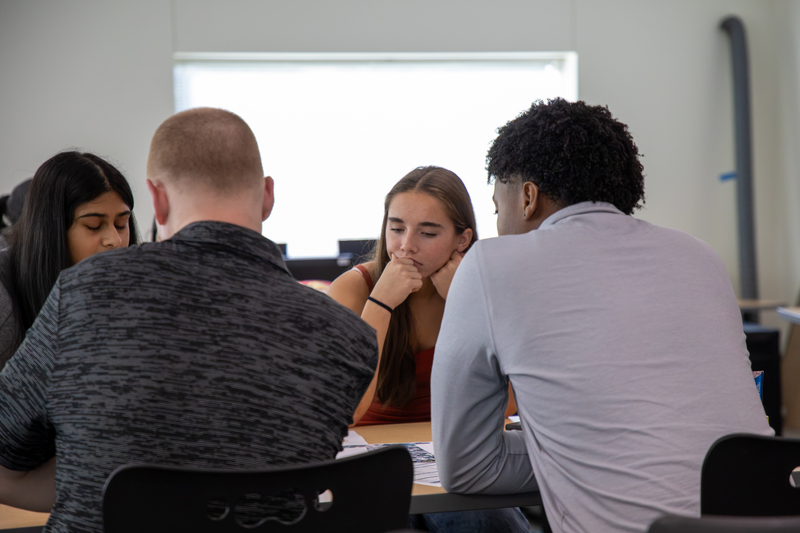
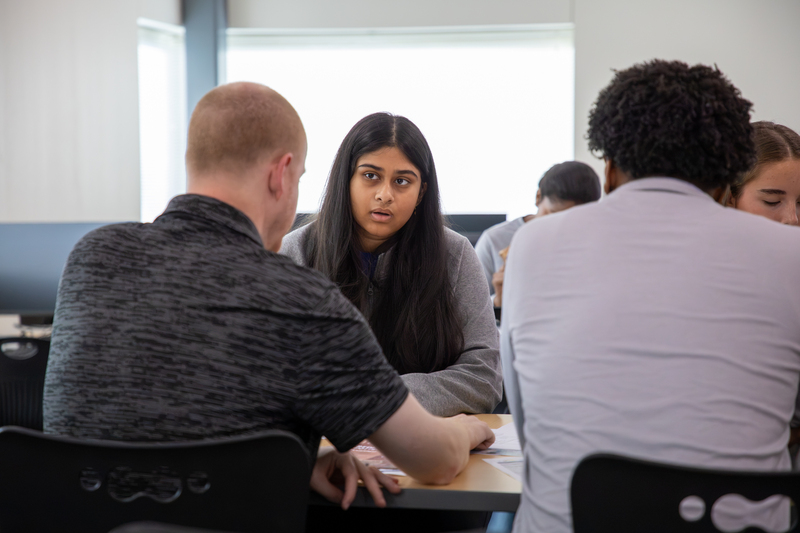
In a recent Architectural Design II class, students were presenting their Montessori academy designs to professionals from architecture firm Corgan, which is facilitating the project. Corgan visits every other week to share feedback and critiques for every stage of the process.
“This project is heavy not just on design but how students need to communicate effectively to be received effectively,” teacher Clarzell Gilleylen said.
Before this visit, students researched their client and site to come up with design concepts. While their teacher is available to help, Neriah said he also gives students leeway to use their own design discretion.
“Going through all four years, I've slowly been able to find my independence in the design process,” she said. “All four classes are built to give the student more creative freedom each year, and by fourth year, the students selected for the program have their own unique styles and creative visions that they use in the classroom.”
Any student can benefit from the communication-focused nature of architecture, but the greatest impact is on students who may want to work in that field.
“If a student chooses to major in architecture, these classes truly set them up for success,” Neriah said.
Education & Training
Class visited: Practicum of Education and Training | Teacher: Nicky Fryman
Internship: Phillips Elementary School Functional Academics classroom | Classroom teacher: Casey Moore
Education & Training programs of study
Nicky Fryman is the first person to tell you, her upper-level CTEC students are probably not in the building.
That’s because she teaches Practicum in Education and Training, where juniors and seniors are actually working as interns in Frisco ISD classrooms during their CTEC class period.
“I want them to experience what being an educator is like day to day, and I want that experience to be as authentic as possible,” Fryman said.
In the first nine weeks, first-year practicum students are learning and working on:
Classroom management and treatment agreements
Writing lesson plans using Kagan strategies
Ron Clark’s Essential 55 book study
Internship reflection journals
Leading small content groups and teaching short lessons in internships
Digital portfolios
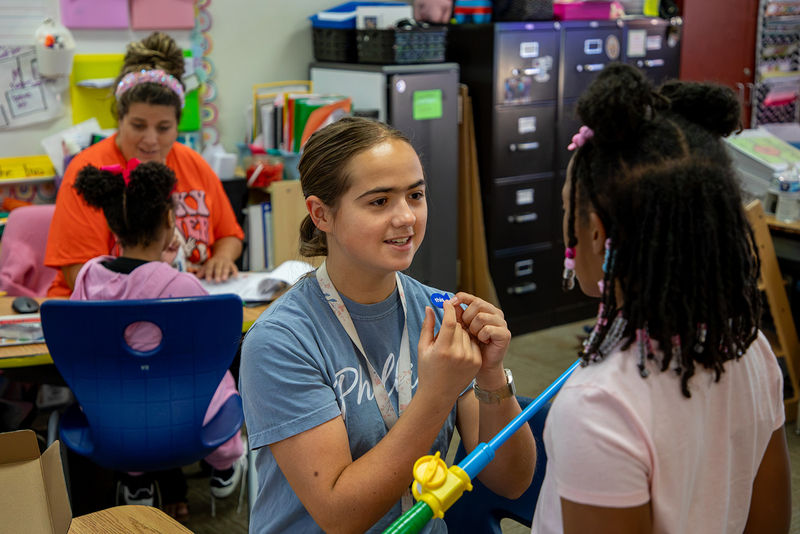
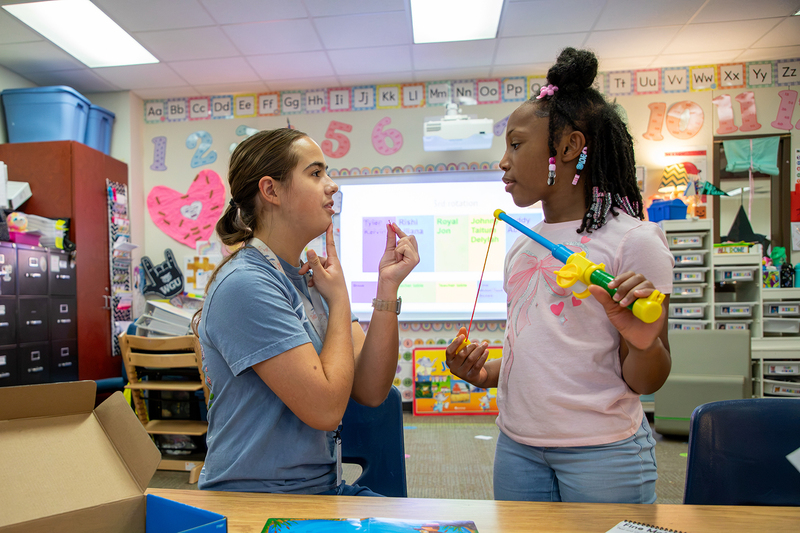
When they aren’t at the CTE Center, they’re interning at FISD elementaries and middle schools. That’s where you can find Claire Durham, a Lone Star senior and intern in a Phillips Elementary special education Functional Academics classroom.
Claire has always wanted to be a teacher, but her goals became specific to special education a few years ago.
“I did Partners P.E. in middle school, and I discovered that not only was I really good at working with people with different abilities, but I also really, really loved it,” Claire said.
On one of her visits to Phillips in the first nine weeks, Claire helped a student with phonics, playing a fishing game to snag sight words and sound them out together. She was encouraging and positive, pointing to her mouth as she demonstrated the word for the student and praising her for her effort.
“Something I have learned already this year is how important encouraging positive self-talk is in working with students,” Claire said. “Often frustration and resistance with work is rooted in the doubt that they can do something, and it is a teacher's job to encourage them to allow them to know that they can do it.”
In her role, Claire also gets to support hands-on learning such as tending to Phillips’ courtyard garden and the flower cart, where FA students learn how to do a job by putting together flower vases for Phillips teachers.
These experiences have helped her solidify her plans.
“Before the internship, I knew I wanted to work with students with different abilities, but I wasn't sure if I wanted to do it in the classroom setting,” Claire said. “This internship has allowed me to see that this is exactly what I want to do with my life.
“I am so excited for the rest of this year and all I will get to learn at this campus,” Claire said.
Both Claire’s practicum teacher and classroom mentor believe she’s on the right track.
“She could graduate tomorrow and be hired as a full-time teacher. She’s that amazing!” Casey Moore, Phillips Elementary teacher and classroom mentor
Engineering
Class visited: PLTW Engineering Design & Development | Teacher: Forrest Metcalf
CTEC’s nationally recognized engineering program is sending students to space — in a manner of speaking.
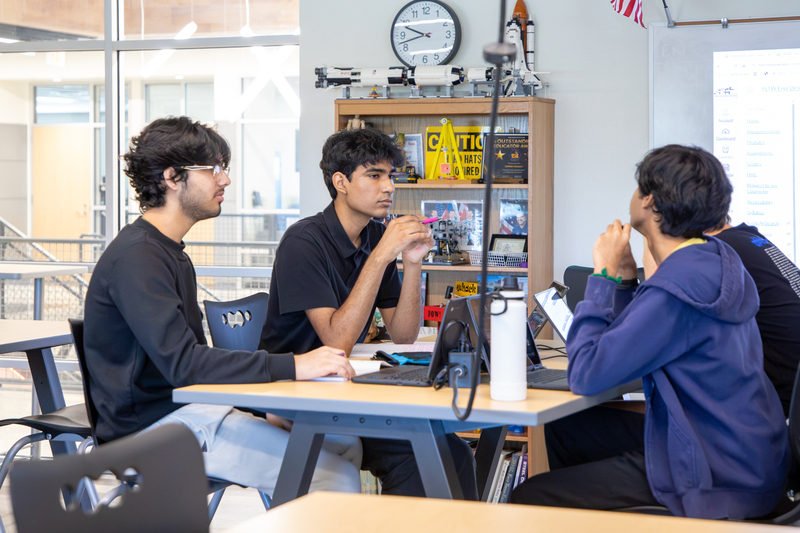
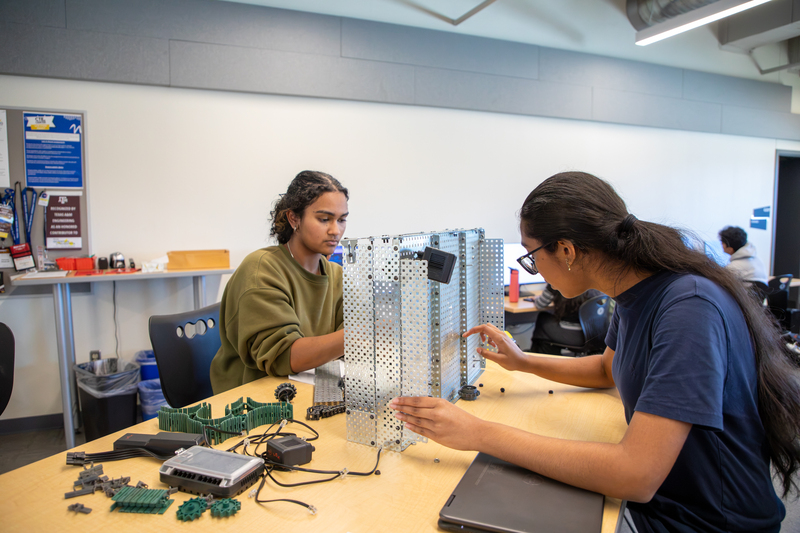
In the first nine weeks, Engineering Design & Development students have been defining a problem they want to spend the year solving. About half chose a NASA HUNCH project, meeting with NASA personnel to solve real challenges astronauts face in space.
This focus on creating solutions, rather than avoiding problems, is a hallmark of CTEC engineering.
In the first nine weeks, engineering students are learning and working on:
Identifying problems, researching and surveying the marketplace to justify their problem.
Designing homes per the Habitat for Humanity specifications.
Learning about the basics of flight design, types of airfoils and the construction of gliders.
Lone Star student Avyan Atre only started down the pathway in his sophomore year but wasted no time with the last three years, and as a senior, he’s taking three engineering courses.
He was instantly hooked on the rigor and material, “from the model car designs, to the infamous statics exam in Principles of Engineering that every single student I heard from dreaded.”
And that dedication paid off last year, when he and four peers worked with CTE Center teacher Robert Dahl on the Go Baby Go partnership with Early Childhood School.
Thanks to the program, ECS staff and Avyan’s team at the CTE Center, 4-year-old Caylei received an adaptive ride-on vehicle this spring. A heartwarming experience, the project also gave Avyan and his peers a chance to work on a technically complex design with a real client in a short time frame.
“Providing Caylei with a wonderful, comfortable and well-executed vehicle can hopefully make a meaningful difference in her and her family’s lives." Avyan Atre , CTE Center student
Medcalf is quick to point to the many other opportunities for engineering students, such as job shadowing experience at firms such as BGE, TexTerra, Westwood, HNTB, and the city of Frisco; the CTE Center Invention Fair; visits from industry partners such as Core Construction and Project Control; and participation in a virtual reality program created by a Texas A&M professor.
These opportunities are not lost on students like Avyan, who has seen the Artemis III crew train and has met an International Space Station flight operations director, as well as engineers, scientists, psychologists, researchers and “a plethora of other careers at the center,” all through CTE Center connections.
“The CTE Center has helped me make moves and connections within my career that has facilitated my growth professionally, socially, as well as technically as an engineer,” he said. “Through my CTE classes, my passion for engineering took flight.”
- Rachel McReynolds